
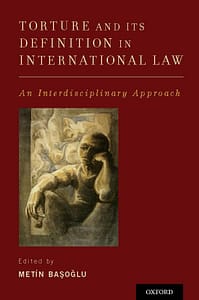
TORTURE AND ITS DEFINITION IN INTERNATIONAL LAW:
AN INTERDISCIPLINARY APPROACH
Edited by METİN BAŞOĞLU
Oxford University Press New York, 2017
This b ook presents an interdisciplinary approach to definition of torture by a group of prominent scholars of behavioral sciences, international law, human rights, and public health with internationally recognized expertise and authority in their field. It brings together behavioral science and international law perspectives on torture in an effort to promote a sound theory- and empirical-evidence-based legal understanding of torture. The book consists of four parts. The behavioral science perspective in Part I includes a learning theory formulation of torture, which points to ‘helplessness under the control of others’ as a defining element of torture. This formulation entails a contextual / cumulative approach in assessment of “pain or suffering” induced by ill-treatments and a ‘risk-based’ approach in assessment of individual cases to avoid the problem of circularity in case-by-case approach. Also reviewed are the definitional implications of this formulation for ill-treatments in different contexts, such as domestic violence and adverse conditions of penal confinement. Part 2 consists of four chapters that present international law perspectives on definition of torture and highlight the increasingly broader coverage of ill-treatments in contexts beyond official custody. Part 3 consists of chapters that provide an account of the U.S. experience with torture in the aftermath of 9/11 and discuss definitional issues around “enhanced interrogation techniques.” Part 4 consists of a concluding chapter (by the editor) that addresses the comments by international law scholars on the behavioral science perspective on torture and reviews the points of agreement and disagreement between behavioral science and international law perspectives.
CLICK HERE FOR PREVIEW OF CONTENTS

Leave a Reply