English articles
-
Abstract The central question of this article is whether Cognitive Behavioral Therapy (CBT) and its so-called third wave derivatives represent genuine progress in the field of psychotherapy. Despite the technical complexity of classical CBT, which comprises cognitive restructuring, behavioral experiments, and various coping skills, there is considerable uncertainty about which components are actually effective. There is considerable evidence that cognitive interventions do not add any additional benefit to behavioral techniques such as exposure to anxiety stimuli or behavioral activation. Approaches collectively referred to as the third wave, such as Acceptance and Commitment Therapy (ACT), Dialectical Behavior Therapy (DBT), and Mindfulness-Based…
-
Abstract In my 2017 book on Torture and Its Definition in International Law: An Interdisciplinary Approach I presented a learning theory formulation of torture to highlight its core definitional characteristics from a behavioral science perspective. These include a) exposure to unpredictable and uncontrollable stressors that pose a risk of helplessness and hopelessness responses and b) such exposure takes place in a setting where the person is under the physical control of others or occurs as a consequence of actions who are in a position to exercise authority or control over the person. Based on a contextual, cumulative, and risk-based approach…
-
TORTURE AND ITS DEFINITION IN INTERNATIONAL LAW: AN INTERDISCIPLINARY APPROACH Edited by METİN BAŞOĞLU Oxford University Press New York, 2017 This book presents an interdisciplinary approach to definition of torture by a group of prominent scholars of behavioral sciences, international law, human rights, and public health with internationally recognized expertise and authority in their field. It brings together behavioral science and international law perspectives on torture in an effort to promote a sound theory- and empirical-evidence-based legal understanding of torture. The book consists of four parts. The behavioral science perspective in Part I includes a learning theory formulation of torture,…
-
The ever-increasing population of the world is being affected by war, environmental degradation, and poverty. Available resources fail to meet the demand for psychological care, given that there is one psychiatrist per every 100,000 in about 70% of the global population. In African countries this ratio is even lower with an average of 5 million people for every psychiatrist. This ratio is possibly lower still for the 43.3 million displaced individuals around the world (UNHCR, 2010). Although European countries are fortunate enough to have an average of one psychiatrist for every 10,000 people (Klecha, Barke, & Gureje, 2004), there is…
-
Abstract The overly restrictive US definition of torture set forth by the “torture memos” in the early aftermath of 9/11 has been widely criticized for excluding “enhanced interrogation techniques” (EITs) and thereby creating loopholes for impunity. In the light of the US Senate Intelligence Committee Report on CIA’s detention and interrogation program confirming the use of EITs to induce “learned helplessness” in detainees, this article reviews the scientific basis for the US definition of torture and its interpretation in the “torture memos.” These memorandums clearly indicate that EITs are designed for use in combination with specific intent to induce learned…
-
In my previous post I reviewed the misconceptions that characterize the debate on torture renewed by the movie Zero Dark Thirty and presented some research evidence showing that waterboarding is one of the most physically and mentally distressing forms of torture. In this article I expand on the issue of waterboarding and review further evidence that has not been previously published. To add some touch of ‘human interest’ to this post I will also tell the story behind the research that generated this evidence and why such important evidence remained unpublished to date. Until the early 1990s there were few…
-
The debate on whether torture works is once again revived, this time by Kathryn Bigelow’s upcoming film Zero Dark Thirty. The responses to the film vary. Frank Bruni of the New York Times, summarizes the movie’s basic message as “no waterboarding, no Bin Ladin” and concludes that it does not “reflect many experts’ belief that torture is unnecessary, yielding as much bad information as good.” MSNBC Morning Joe host Joe Scarborough disagrees by arguing that the information leading to Bin Ladin was obtained through waterboarding. He believes that indiscriminate drone strikes killing civilians “are a little rougher than waterboarding three terrorists” and therefore…
-
Summary Currently much debate centers on the issue of whether drone strikes radicalize some people and increase the risk of retaliatory attacks. This article addresses this issue by presenting some research data demonstrating that war violence with similar contextual characteristics as drone warfare have certain cognitive and emotional effects (e.g. sense of injustice, anger, outrage, helplessness, loss of meaning in life, and desire for revenge) that are indistinguishable from those of torture in their nature and intensity. Such emotional reactions in humans possibly reflect evolutionarily-determined responses to threats to their physical and psychological well-being. As such, they could well contribute…
-
SUMMARY Much of the current debate about the morality and legality of drone warfare focuses on the number of civilian casualties with little attention to its mental health, socio-economic, cultural, and political consequences. A recent study in Pakistan by the Stanford Law School and New York University (NYU) School of Law suggests that such outcomes of drone strikes need serious consideration. This article presents a learning theory analysis of the contextual trauma characteristics of drone warfare and systematic torture and points to striking commonalities between these two ostensibly different traumatic events. Substantial evidence shows that helplessness induced by unpredictable and…
-
I have recently received a copy of a paper presented at the 12th European Conference on Traumatic Stress in Vienna in June 2011 by psychologist Nora Sveaas from the Department of Psychology of University of Oslo. Dr. Sveaas is also a member of the UN Committee against Torture (CAT). Her paper (entitled Gross human rights violations and reparation: rehabilitation as form of reparation under international law –challenges and approaches) deals with the important issue of redress for survivors of torture and reviews aspects of the CAT Working Document on Article 14, which has been posted in the CAT website for…
-
In my previous post I had pointed to ill-informed comments from mental health professionals about the mental health effects of Japan disaster. I will expand on this issue a bit further by highlighting how “expert” opinion on this issue is plagued by various common misconceptions about earthquake trauma. There are numerous examples of this in the media but I will focus on only a select few. A New York Times article – Lessons for Japan’s Survivors: The psychology of recovery – based on expert opinions illustrates some of the most common misconceptions in the field of psychological trauma. There are…
-
Since the disaster in Japan, I have been coming across in the Internet expressions of opinions or recommendations by various Western mental health professionals as to how Japan should go about helping survivors recover from trauma. Most recommendations as to what survivors should do to recover from their trauma are simply reiterations of widely accepted but largely unsubstantiated opinions that characterize much of the current thinking in the field of psychological trauma. I suspect there must be some Western mental health professionals liaising with their Japanese colleagues to offer them guidance in their work. National or international relief agencies may…
-
The recent 9.0-magnitude earthquake in Japan and the devastating tsunami that followed are likely to lead to widespread mental health problems in survivors. Based on our research with earthquake survivors in Turkey, we would expect traumatic stress problems severe enough to require treatment in more than 50% of the people with high levels of expoure to trauma exposure . Such a high rate can be attributed to mainly 3 types of stressor events experienced by the Japanese people: (1) earthquake tremors, including the initial major shock and the aftershocks, (2) the devastating impact of the tsunami, and (3) threat of exposure…
-
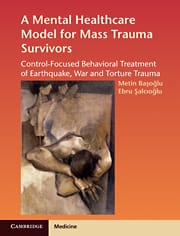
After the earthquakes in New Zealand and Japan, I have been getting requests for information about treatment of earthquake survivors from mental health professionals. Below is a list of our publications about treatment of earthquake survivors (updated March 2013). Book Basoglu M, Salcioglu E (2011) A mental healthcare model for mass trauma survivors: Control-Focused Behavioral Treatment of earthquake, war, and torture trauma. Cambridge University Press. Articles Salcioglu E, Basoglu M. (2013) Current State of the Art in Treatment of Posttraumatic Stress Disorder. In F. Durbano (Ed.) New Insights into Anxiety Disorders. http://dx.doi.org/10.5772/54197 Salcioglu E, Basoglu M. (2010) Control focused behavioral…